Thursday, November 1, 2012

And thanks everyone for visiting this blog and helping me build it. I know I've been a bad blogger this season, but life upheaval has intervened. But I've enjoyed every minute of the growing and blogging experience.
See you at the new place!
Monday, October 22, 2012
Am I Like Where's Waldo?
Tuesday, May 8, 2012
Update from TomatoLand
First, no, I did not get run over by a bus. I'm still alive and kicking, although I'm eating a lot fewer fresh veggies because I had to take the garden out already this year. This last season, though, was just wonderful. I grew fewer plants than normal and had to scale back some of my loftier ambitions, but still had one of the most spectacular harvest years I've had in a while. The four main varieties I grew--Better Boy, Paul Robeson, Kellogg's Breakfast, and striped zebra--all performed like mad. I had to give a special notice to the Better Boys, which must have put out 30 pounds of fruit quickly. The Kellogg's Breakfast were also pretty amazing ... huge, juicy orange fruit. Now, it turns out I'm not the world's biggest fan of orange tomatoes (I like my tomatoes a little more acidic), but I'd still grow them again just for the sheer novelty of tomatoes that look like small basketballs.
But why, then? Why did I take the garden out early?
Well, referencing my last post (ye ole robbery), we are in the process of moving. We're relocating locally, but we've been getting the house ready and doing repairs, etc. That unfortunately included taking out the winter garden. Like many people, we have a small yard, so every winter I build an edifice to veggies in the backyard, but every trace of it disappears in the summer so the family can actually use the yard and pool without dodging containers. This year, it happened a bit early so we can have people through the house.
I am also getting a fair number of people enquiring about starting veggie gardens now. Here's my answer: resist the urge. I can already anticipate there are those among you who are outraged at the very idea. "But I've been growing veggies in South Florida summers for years!" Yes, yes. I know. I know people who do it too, and do it well. But in my opinion, that's a game for the experienced grower because there are many more challenges. Nevertheless, if you must plant veggies this summer, stick with hot-season crops like okra, African long beans, and eggplant. In terms of tomatoes, you can also grow the tiny and quite tasty Everglades cherry tomato. The trick is finding seeds, but they're rampant growers even in the summer.
Anyway, thanks everybody for sticking with me this season and it's been great to hear that so many people had great harvests this year. Take that, bland mass-produced tomatoes! We're coming for you ...
Thursday, February 2, 2012
Best One-Day Harvest in a Long Time

Monday, January 23, 2012
A Quick Harvest Picture

Wednesday, January 4, 2012
Day Two: Tomatoes and Cold Weather


Tuesday, January 3, 2012
Damn Wind


Monday, January 2, 2012
Cover 'Em Up
- Deeply water the tomatoes as night sets in. Water is a great insulation and protects tender roots. As you water at night, though, make extra sure not to get any water on the leaves.
- Cover the tomatoes with sheets. Try to get as much coverage as possible.
Friday, December 23, 2011
Morning, Tomato People!

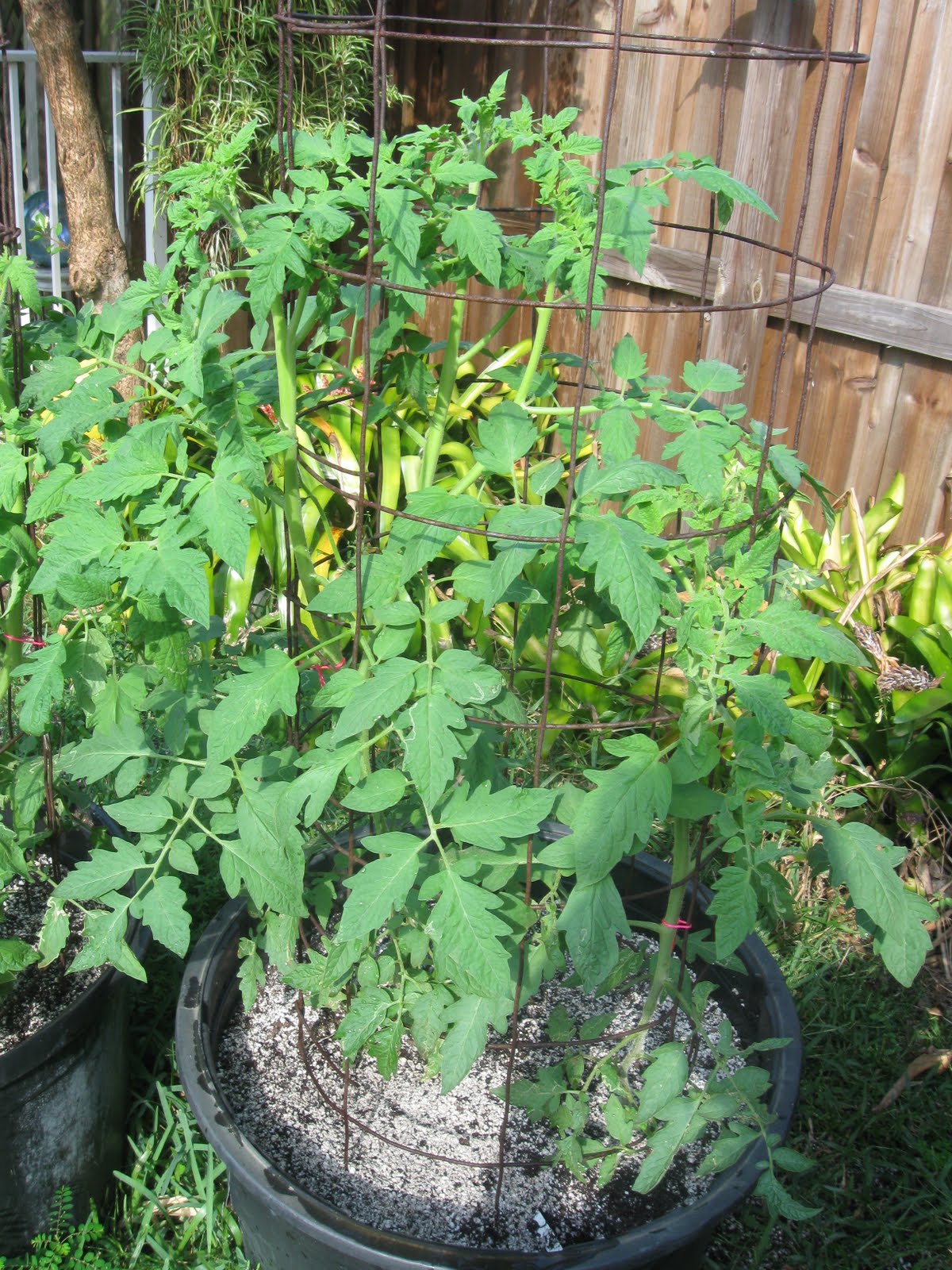
 Good morning! I was watering this morning and took a few pictures so I could post. This season has continued its near-magical trajectory. I'm still feeding weekly with Tomato-tone organic fertilizer, but I've stopped spraying with the Key-Plex and copper fungicide. I've had to remove a few leaves with spots, but nothing I'm worried about. I also had a small problem with white flies over the last two weeks, but I treated with neem oil and they seem to be mostly in hand. There are still a few, but the population is much reduced. Other than that, I'm still watering every day and spending my mornings pinching off suckers and tying up plants. Last week, I had to extend my tomato cages to 8 feet because of overgrowth. I've topped all the plants at this point, but they're still trying to get up there, and since the sun is better up high, I want to let them get as tall as I can handle it to set more fruit up there.
Wednesday, November 23, 2011
On Magic Dust
Monday, October 24, 2011
And They're Underway ...
- Neem oil. I've not used neem on tomatoes, but overall it's kind of wonderful stuff. It's an insecticide with anti-bacterial and anti-fungal properties. It's very safe for humans, and I've already started treating the plants once a week with it.
- Copper fungicide. This is an organic fungicide. I'm using it as a weekly spray to prevent early season fungus from taking hold (hopefully).
- BT (bacillus thuriengiensis). This is the mother of all anti-caterpillar treatments. I use the powder and sprinkle it on the plants liberally maybe once a month or so.
- Fafard 3B Professional Mix, which is basically just composted peat moss, perlite, pine bark fines, and dolomite lime
- Composted cow manure, for a slight organic food boost
- Perlite, to air out the mix after I add the cow manure (which is too heavy for good drainage, and good drainage is ESSENTIAL for good plant growth)
- Dolomite lime, just a few tablespoons to boost the calcium and counteract the manure's acidity
- Blood meal, for nitrogen
- Bone meal, for another boost of calcium
Thursday, October 6, 2011
Now Here's Something Interesting

I know that's the same photo I just used, but I wanted it for contrast. This plant already has several sets of mature leaves and is as tall as my hand.

Wednesday, October 5, 2011
Seedlings, Day 15
 I love this time of year. This mildly cool, breezy spell we're having is great. I'm outside every morning, watering and moving seedling trays, and it only reminds me that we're really heading into the fall and winter almost-Mediterranean growing season.
Saturday, October 1, 2011
Oct. 1 ... 1,000% No
 Very cute, right? A nice little tray of seedlings popping up in their hydroponic home. Before I get to the part about wanting to poke my eyes out with a bamboo skewer, I'll talk about how the AeroGarden seedling tray worked. At first, I was amazed. Most of my seedlings sprouted within a day or two, instead of the usual three to four days (I took this shot just a few days after planting, not today), and they grew faster than I'd ever seen seedlings grow. Within no time at all, I had a bushy little garden of seedlings going and I was starting to think I was pretty smart.
 Wednesday, September 21, 2011
Seedlings: Day 1 (A New Start)
 Whew. So, here it is, September 21, and I'm finally getting things underway. Believe me, these last two weeks have been a massive exercise in self-control not to plant, but I kept having to remind myself that the season is long and, at least with non-disease-resistant heirloom tomatoes, I'm not so sure the early bird gets the worm.
Monday, August 22, 2011
The Plan
- Green Zebra tomatoes (25 gal. container)
- Brandy Boy tomatoes (25 gal. container). I understand this is a controversial choice among many serious tomato growers. Brandy Boy is a hybrid created by Burpee seed company. It supposedly has the taste of the Brandywine, which is stellar, plus better disease resistance and vigor. The problem is, many people who are serious about heirlooms really detest Burpee, for a whole bunch of reasons. I get it. But I've heard good things about this tomato and I figured I'd give it a try.
- Kellogg's Breakfast tomatoes (25 gal. container). Giant orange beefsteak tomatoes. They're a bit trendy, sure, but they're Giant Orange Beefsteak Tomatoes. I'm in.
- Paul Robeson tomatoes (25 gal. container). I'm ridiculously excited about these. The Paul Robeson is a black tomato, similar to the Cherokee Purple, with a supposedly excellent flavor. I can't wait to see if these live up to the hype.
- Laroma III paste tomatoes (2 x 15 gal. containers). I like a lot of paste tomatoes for salsa and whatnot. These are VFFNA, so they should have good disease resistance.
- Various lettuce greens. This includes a mescal mix, mustard greens, and Swiss chard. I've been on a big greens kick this year. Not only are leafy greens great for you, they're just good.
- Strawberries (AgroTower stackable containers). I'm doing another tower of strawberries, but this time a smaller one. We shall see.
- Broccoli (Earthbox). This is a no-fail way to produce awesome broccoli.
- Habanero peppers (Earthbox). Chocolate habanero (see above: salsa).
- Bell peppers (Earthbox). Because they rule.
- Herbs. Probably a full herb garden ... plus I established lemon grass over the summer, so I've got lots of Thai food growing in my yard.
Wednesday, April 27, 2011
Tomatoes in Earthboxes (A Reader's Perspective)


Monday, April 4, 2011
Hydroponic Tomatoes

One of the great things about running this blog is getting pictures from fellow gardeners all over South Florida of their own tomato gardens. This year in particular, I've gotten a few from gardeners who are doing pretty incredible things ... including Brian. Brian grows hydroponic tomatoes in a set-up he created himself, and he's probably too modest to say it, but he strikes me as a mad genius. So I asked Brian if he'd be willing to share his method and he agreed. For the uninitiated among us, hydroponics is the practice of growing plants in a water/nutrient solution, without soil or potting media. The plants are rooted in a sterile mixture for support, and they obtain their nutrients directly from the water. In addition, root-zone aeration is increased, sometimes dramatically, depending on the type of hydroponic setup you're using. But I'll let Brian tell the rest ... 1. So you're growing tomatoes hydroponically outdoors. How did you decide to go that route and what's your basic set-up look like? In a nutshell, my local soil stinks. I already had a 440-gallon rain barrel collection setup, so trying hydroponics made sense. I researched hydroponics on the Internet and it sounded promising. I decided to set up a test garden and see how it went. I chose the ebb and flow method as it seemed to meet my needs with the least hassle. The growing medium I chose was coco coir with a layer of red lava rock under it for added drainage. For my test setup, I used eight 5-gallon buckets, which I connected together using 1" PVC pipe and fittings. I used an old 15 gal. fish tank for my nutrient tank, and with some creative pipe work, I came up with a system that fills, drains, and controls overflow all from one point. 2. How many plants do you grow in each container? What kind of harvest are you getting? My test garden consisted of five buckets with two tomato plants in each, one bucket had six silver queen corn plants, one bucket with basil, one bucket with six blue lake green bean plants, and on a whim, I planted a pumpkin seed from the Halloween jack-o-lantern I carved. All plants were started on November 1 from seed indoors using Rapid Rooter plugs and a fluorescent light. The harvest was beyond my expectations. Let's just say all the neighbors on my street received tomatoes. I never counted exactly, but the ten plants yielded close to 100 tomatoes, and there are still a few on the vine. Most were in the 1 lb+ range with a few coming close to 2 lbs. The six corn plants produced four usable ears, two of which filled in close to 100 percent. The basil grew like a weed; I would top it in half, and a week later it looked like I didn't touch it. The green beans produced four double handfuls of beautiful beans. The biggest kick I got was the pumpkin plant. I didn't even expect it to sprout. Not only did it sprout, it actually produced a pumpkin! 3. What was the hardest part to get right? I've heard that outdoor hydro is hard because of rain water, animals, etc., encroaching on the growing containers. Did you have issues like this? My hydroponic garden is a work in progress so I can't say I've got it right yet! I have had great results so far with a few bumps. I think the most confusing issue I had was which nutrient solution to use. There are hundreds of them: powders, liquids, two-part mixes, three-part mixes, etc. It can be overwhelming to a novice, which I was. The other critical factor in hydro is the nutrient tanks' PH level. It's very important to monitor it and keep it within the range for what you're growing. It's easy to do, but must be done if you want great results. Rain really hasn't been a issue up to this point. I'm a bit of a weather junkie so I check the radar daily. When rain is heading my way, I simply disconnect a fitting and the rain water flows through the buckets and onto the ground instead of back into the nutrient tank, which would dilute it. In reality, having your plants get a good rain is benificial, as it's recommended you flush your buckets with fresh water every week or so. This eliminates the buildup of unused nutrients and salts that can settle in the bottom of your buckets. Salts will block the roots from absorbing the nutrients they need. Surprisingly, the local critters have ignored my garden completely. We have racoons, opossums, and of course, birds. I haven't seen one bite or peck up to this point, knock on wood. My best guess is the neighbors leave enough dog/cat food outside to keep the wild critters content. 4. If someone wanted to start growing hydro tomatoes, where should they go for good information and resources? How can I get started? Try www.simplyhydro.com. It's a great resource for the hydroponic beginner. It's a cleanly designed website with easy reading and clear information. Ive done my travels through the hydroponic web and their website is on target. As far as tomato-specific websites, there are too many to remember, all with varying opinions. I took in as much information as I could and tried to balance it with my situation. You have to remember what works for a gal in Ohio might not work for us here in South Florida. Bugs, weather, etc. It's all different. One great local resource for hydroponic information and products is Greentouch Hydroponics in Davie (5011 S. State Rd. 7, suite 104, 954-316-8815). Carey and Mike who work there are both very knowledgeble and helpful. Mike can go into detail on micronutrients like nobody's business. His nickname, Ozone, is well deserved. It's by far the best local Hydroponics store in Broward in my opinion. For online shopping, another great resource for hydroponic stuff is Grow Smart Hydroponics. They have fast shipping and great pricing and helpful staff as well. 5. What varieties of tomatoes are you growing? Do you have problems with fungal and bacterial diseases, etc.? My first test setup, I planted Burpee Super beefsteak hybrids. They did great. The flavor was OK, and the size and quantity were outstanding. I currently have a second setup with another Burpee beefsteak variety just starting to flower. In the nursery, I have Heinz and Brandywine varieties almost ready for transplant. To me, the Brandywine will be the real test of my hydroponic setup. As you know, they can be finicky so I'm excited to get them going. Up to this point, powdery mildew has been my biggest fungal issue. It went untreated in the first test setup of tomatoes due to it showing up so late in the plant's development. The plants had already given me 50+ tomatoes, so I decided to let it go as the plants would be replaced soon with new ones. I've since been using preventitive spraying of Neem oil and seem to have the issue under control. Like everyone it seems, I have had some mystery leaf curl issues as well, but no real harm done there. (From Jon ... if you have any questions about the particulars, leave them in the comments section and I'll make sure they get answered!) |
Wednesday, March 23, 2011
Reviewing This Year's Varieties
 So the season seems to have entered the final stretch ... this is right about the time I'm starting to think about lessons I've learned this season, start to plan for next season, and in general wonder where the growing season went. Don't get me wrong, I love summer (even our summers), but it's hard not to miss the growing season.
 - Brandywine: Amazing taste, beautiful tomato, the rightful queen of TomatoLand. After fending off massive disease problems with an aggressive spraying program, I got a medium yield of medium to large fruit. Still, just on bragging rights alone, this is a winner, and my friends and family loved them. My advice: if you're going to grow these, plan on spraying from the beginning.
- Cherokee purple. Beautifully colored, excellent fruit. I'll definitely grow these again—people regularly ask me if I have any more to give away. I also got a pretty heavy yield for an heirloom, although the fruit were generally a bit smaller than the Brandywines. It was somewhat more disease resistant than the Brandywine and ripened earlier, although they were also sprayed. The same advice applies here: if you're going to grow them, plan on spraying.
- Yellow pear. Slow to start, but once it kicked in, I got loads and loads of fruit. Whole baskets full of these things. They are very sweet and delicious and I got in the habit of leaving them around in bowls as snack food. I lost two plants, though, to yellow frizzy top disease.
- Victoria Supreme. Excellent disease resistance. Of all the tomatoes I grew this year, these were the only ones that didn't get sprayed at all. It's a great cooking tomato with very few seeds and quickly cooks down into a thick, rich sauce. I made up a sausage and pepper tomato sauce midway through the season, with fresh parmesan and a handful of basil, that was a big hit this winter. I'd grow these again as a standard paste tomato.
- Big Boy. Well, they grew at least. I dunno. These are pretty dependable producers, aside from some splitting, and they have great disease resistance. They're quite lovely, too. But in a side-by-side taste test with Brandwines, they just ... squish a bit in comparison.
- Early Wonders. I can see the appeal of a tomato that ripens in fifty days. It's really pretty amazing, especially considering that some of the others went WAY past their anticipated harvest dates before I started getting fruit. But these ... well, I don't want to speak ill of a tomato. Let's just say the flavor was insipid to middling and the skin was vaguely reptilian. I won't grow them again.

 Posts
Posts


